

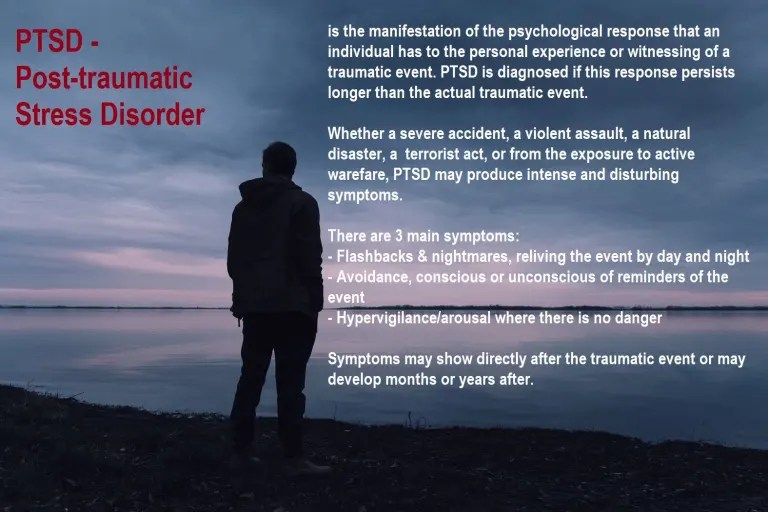
The symptom complex of PTSD, post-traumatic-stress disorder, exhibits a specific and individualized symptomatology. Homeopathy has a number of remedies at its disposal, with which this particular symptom complex and its individual expression can be treated. Some of the remedies that may be useful in treating PTSD are listed below.

Absinthium: The patient needing this remedy may experience nervousness and sleeplessness, has visions and hallucinations that are frightening and terrifying. The patient may have the urge to walk, distressed by the visions of all sorts of demons. He or she does not care whether he or she lives or dies. He or she does not want to engage with others. There may be a tendency to brutality and violence. This may alternate with stupor.
Aconitum: There is great and uncontrollable anguish, fear and anxiety; irritability, sadness and gloom. Much worry, uneasiness and fear accompanies even ordinary sickness. He or she fears there will be no recovery from illness. He or she may predict the day of his death. There is nervousness and weakness. The individual may have fear to leave the house, of being in a crowd. Complaints may come from situations of fright or fear. In states of deliria the patient needing Aconitum is unhappy, worries, raves and despairs over the fearful anticipation of his or her death. There is sadness, maliciousness, a high disposition to anger, fear and conflict. There is a sensitivity to noise, a dislike of communication, a vexation over trifles. Great irritation, nervousness, restlessness and excitement are characteristic. A fear of spectres, the dark, forebodings and a tendency to start are also prevalent, as is the disposition to run away from the locality. Aconite is a short-acting remedy for the acute states.
Agaricus: This remedy is characterized by great changeability, irritability, and depression. There is a state of delirium with confusion of the mind. The individual wishes not to engage in communication with others.An indisposition to mental or other labour. There may be timid or violent mania with persistent delirium in which he or she recognizes no one and throws objects around. The individual is morose and stubborn.
Anacardium: This remedy has fixed ideas and hallucinations. He or she is easily offended; contradiction makes him or her furious. The individual expresses anxiety over somebody following him or her when moving about. There is deep melancholy and hypochondriasis. There is depression, sadness and despair over health. The patient is suspicious and distrusting. He or she can be malicious with an absence of moral restraint. Absent mindedness, dullness and sluggishness of mind may be prevalent. He or she may be hearing voices and may have hallucinations. There is anxiety, despair over the future, even fear of nearing death.
Anhalonium: In this remedy there is distrust and resentment. The individual is confused, and delusional. There may be a depersonalisation taking place within the patient. He or she may be dissociated from his or her nearest environment. Likewise there may be over-identification with that environment. The feeling for time and reality is lost.
Ambra grisea: Ambra dreads the company of people and wants to be alone. He or she is shy in the presence of others. The individual can despair over life to the extent that he or she loathes life. He or she is restless, excitable and loquacious. Concentration is difficult for this individual. There may be confusion of thoughts. He or she is ‘forced’ to dwell on disagreeable things. These things can be fantastic hallucinations images, grimaces, fancies, visions, or imaginations. They are annoying to him or her and keep the patient from sleeping. The company of others is experienced as disturbing. There is the feeling of embarrassment, with nervous excitement, flushing, and trembling. The individual imagines that he or she is losing his or her mind which causes melancholy, great sadness and despair to the extent that the patient desires to die. He or she considers life unworthy of living. Ambra is the distinctive picture of an individual who used to be a vital, vigorous and strong person, and since the causative experiences is a broken, nervous, quivering, trembling wreckage.
Arsenicum album: A remedy that is indicated for great anguish accompanied by restlessness. There is fear is of death, of being left alone. The fear is also accompanied by cold sweat. The individual takes no medicines as he or she thinks these are useless. He or she may have olfactory and auditory hallucinations, may be delusional with a tendency to mania and delirium. He or she is sensitive to confusion and disorder. These make him or her anxious, prostrated, fearful and restless. The restlessness keeps the person in movement. He or she does not stay still. As the individual may be of selfish character, lacking courage, being miserly may incline him or her to be malicious or suicidal. This individual may be extremely sad, melancholic, and such a state may make him or her weary of life, loathing it, wanting to die, and this character may actually commit suicide.
Aurum metallicum: The patient needing Aurum exhibits feelings of self-condemnation, utter worthlessness, deep despondency, and a deep disgust for life. These make him develop a tendency to want to commit suicide. He or she truly loathes life, is weary of it even desires to die. This is a deep depression, a profound melancholy that robs the individual of all that is joyous in his or her environment. He or she fears death. He is grumpy, broody, and extremely sensitive to noise and commotion around him or her. He or she cannot handle contradiction, is quarrelsome. He is a very dutiful character and sees criticism as consequence of a sin, a neglect he or she has committed. Therefore he or she thinks him or herself as unworthy of salvation. He or she is a pessimist, expects things to go wrong, and sees only the negative, never the positive. The future is negative; there is only trouble, turmoil ahead. This makes him or her irritable, worried, and easily angered.
Gelsemium: This is a remedy for the ill effects coming from the exposure to fear, fright, disruptive news or other emotional excitement. There is languor, dullness, apathy, lethargy, deliria. He or she wants to be alone, quiet; is irritable, sensitive, depressed. The individual cannot concentrate; the mind feels empty, dull. There is a strong tendency to suicide. This individual has the urge to throw him or herself out of a window or from a height.
Kalium bromatum: In this remedy there is a deep delusion of being morally deficient and of conspiracies building against him or her, feels singled out. Fears of getting poisoned, has frightful nightmares, horrible illusions, is depressed and melancholic.
Natrium muriaticum: In this remedy ailments are produced by mental disposition; anger, grief, fear and fright. The individual is irritable, tearful, sad, and even hysterical. He or she can get into a rage about trifles, and can be tragically moved about little unimportant things; can be inappropriately joyful. There is anxiety and anguish concerning the future. The individual prefers solitude to company, is unable to conduct regular intellectual work, is indifferent to his or her surroundings. Depression and melancholy induce recollection of unpleasant incidences. There are gloomy forebodings to him or her. Patients become tearful, yet attempts of consolation worsen the state. They fly into a rage easily and hold a grudge against people that have previously wronged them. There is weakness of memory, forgetfulness, and patients are tired of life.
Opium: Opium has frightful visions with fear, anxiety and uneasiness. The individual starts easily and is easily excitable. There is inquietude, irritability, and anxiety. There may be alternating phases with pleasant reveries. The individual may express symptoms of stupidity and imbecility. In delirium these individuals do not recognize their surroundings, cannot judge what goes on around them. Morphium (derivative of Opium): This remedy is one for states of shock that have been caused by experiences of terror. He or she is as in a dream-like state. Yet they may be irritable. There is a deep depression and the individual may be hysterical.
Nitricum acidum: This is a headstrong person, who can be hateful and vindictive. He or she may be indifferent to all. There is a sense of hopelessness and despair over his or her health. He or she fears death, yet is tired of life, and takes no joy in anything. He or she is obstinate, wishes not to be consoled; is depressed, sad. Great melancholy and fits of anguish are prominent. Can become enraged about trifles, curses, is obstinate and resentful. He or she is easily startled and frightened, sensitive to noise, touch and pain; weeps easily. This individual becomes angry over his or her own mistakes. He or she does not want to engage in communication with his or her surroundings. This person may have a great weakness of memory and intellectual capability and may be unfit to conduct work.
Stramonium: This individual can be deluded about who he is. He or she cannot be alone or in the dark. He or she needs company in an illuminated environment. There is rage, frenzy, fury, uproar, violence, and tumultuousness. He or she curses, is lewd and abusive in his or her language. There is fear and anxiety. Joy and sadness can alternate quickly. There are hallucination and delusion that the patient considers true and cannot release him or herself from. The sadness and melancholy of this remedy can be tearful and with great anguish. He or she is inconsolable, and trifles irritate much. The individual is obstinate, choleric, self-willed. He or she, in phases of fury, may be inclined to hit, bite and even kill. This is a mania caused by shock. The individual may be indifferent to matters at one time; feeling incapacitated at another, and may have the desire to run from it all.
*** This record serves as an illustration of what remedies are in use in the treatment of PTSD. The list is NOT exhaustive. None of the remedies should be used for self-prescribing. Please see a homeopath to identify the best matching prescription for you! Homeopaths have been trained to identify subtle differences in symptoms and remedy pictures and these subtle differences are important to identify the best possible remedy for a patient.***







 Gentle Help