


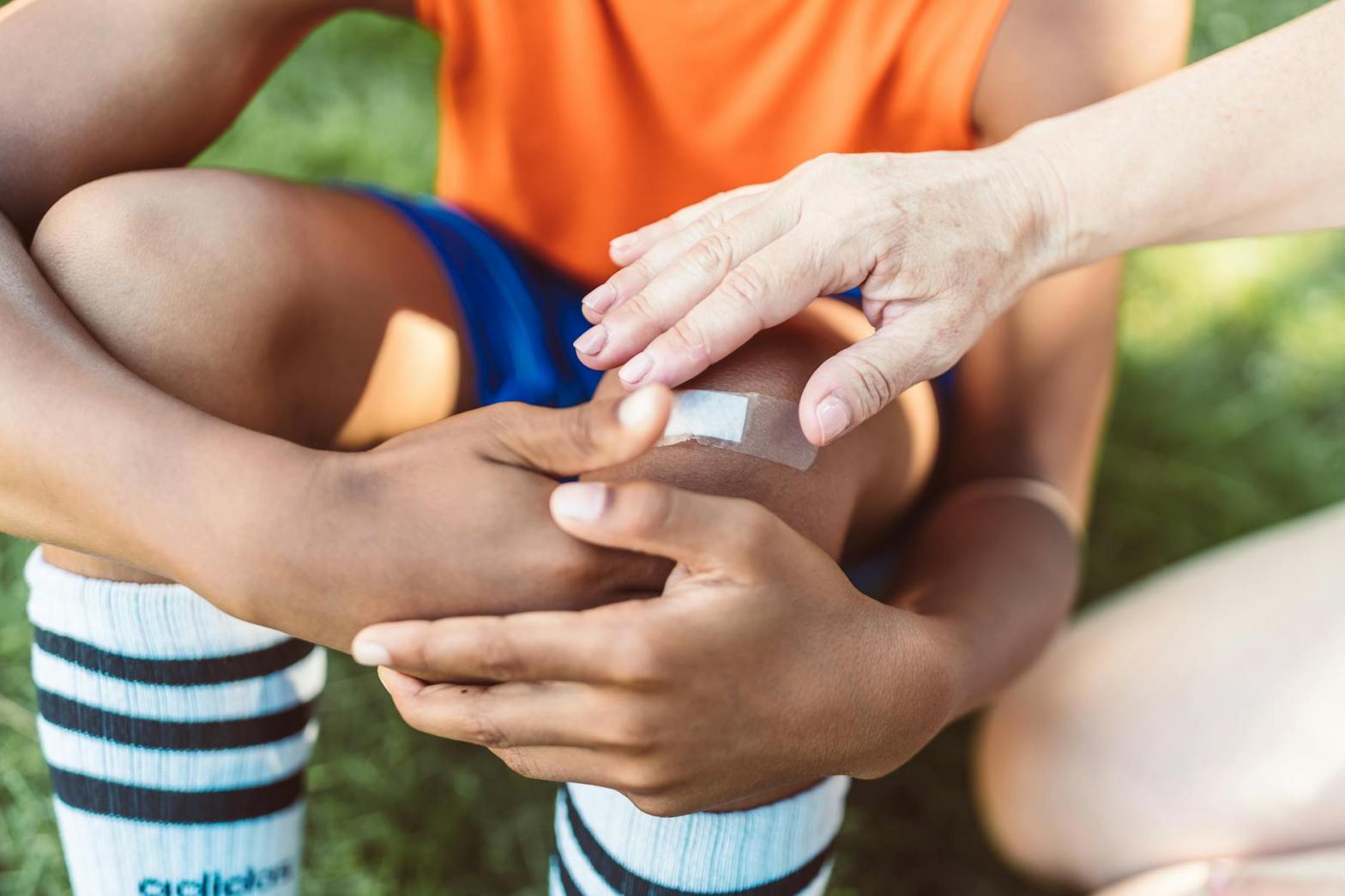
One major remedy for the effects of sports-injuries or such afflictions caused by physical activity, external, or mechanical impact is Arnica. Trauma, bruises, or strains caused by heavy lifting, falling, or shock; concussion, contusion, sprains, or dislocation belong to this group. Hematoma, haemorrhage and wound healing, over-exertion and delayed-onset-muscle-soreness are also indicated symptoms, and Arnica has marked characteristics that match such affections.
One principal aspect pertaining to Arnica is the sensation of pain that feels as if beaten and bruised. The aggravation of Arnica symptoms occurs due to talking, blowing the nose, touch, jolting, movement and slightest noise. The Patient generally feels worse in the evening or at night. Humid cold disagrees with this patient. There may be fainting following a mechanical impact or injuries and there is a generalized decline of strength and fatigue, a battered feeling throughout the body. The entire body may feel painfully oversensitive. There is a general restlessness. The patient may be fearful and irritable.
There may be the sensation of heat and burning in the head with coldness of the body. The Arnica face may have pronounced redness, burning, heat, shining swelling and hardness of just one cheek. While the head and face are heated or hot, the body is cold. Arnica easily suffers of nose-bleed.
Where there is inflammation Arnica is indicated for over-sensitiveness experienced in the entire body, a feeling of being battered, pain, general restlessness, irritability and fear.
The sore excoriation of skin, swelling that is hot, hard and red, as well as frostbites react to Arnica. Joints feel as though they are sprained. Strains and Sprains show redness, pain and restricted mobility, and there may be swelling and heat of the affected part (also Rhus toxicodendron). Hematoma of the skin may be of discoloration red, bluish, yellow, green or black. For wound healing Calendula may be indicated besides Arnica. Topical applications of Arnica are indicated for localized injuries, scalds and burns, incisions, lacerations fractures and bruises and muscle soreness.
In concussion of the brain, the pain in the head is concentrated over one eye, and there may be vomiting that is greenish in color. If in such cases Arnica fails, Cicuta virosa may benefit the patient.
Back pain or straining of the back, or of the chest and loins may feel bruised or as of a dislocation. In injuries to the chest Arnica in alternation with Aconitum may be serviceable. There may be a sensation of rawness, and weakness of the muscles in the neck that cannot support the head sufficiently causing it to fall backwards.
The extremities may have symptoms of pain that feel as of a dislocation or as from great fatigue. Stiffness of the limbs, weariness and muscular jerking may be present after physical exertion. There is great soreness that may be paired with the acute sensation of tension and stretching in the lower limbs. The affected area, legs and feet, or joints may have a crawling or tingling sensation, or a prickling feeling from without inward. In the upper limbs, the joints, wrists, hands and arms may feel sore, as if sprained or dislocated, with a tingling sensation, pins and needles.
In the knee there may be tension pain, as of a contraction of the tendons, and failing strength in the knee-joint when walking, almost paralytic (also in the hip). The knee may be pale and swollen. Movement aggravates the pain. If the big toe is affected, it may be painful, hot, hard and swollen, leaving the skin shining.
In contusions there is a battered feeling, which may be paired with restlessness in contortion and sprain. Besides Arnica, Helianthus anuus may be of use in contusion. In dislocation and luxation there may be violent pains, swelling, and impaired mobility where the extremity is deformed or has an altered direction, here Aconitum may follow Arnica for relief pain. In tennis elbow Arnica is indicated, as well as Ruta. In fractures, Arnica may be followed by Symphytum and Ruta to promote healing of the broken bone.
References:
- Beuchelt H. Praxis der wissenschaftlichen Homöopathie. Leipzig: Georg Thieme, 1949.
- Boericke W. Homeopathic materia medica and repertory. Delhi: B. Jain Publishers Pvt. Ltd., 2004
- Clarke J. A dictionary of practical materia medica. New Delhi: B. Jain Publishers Pvt. Ltd., 1994.
- DHU (2011) Homöopathisches RepetitoriumKarlsruhe: Deutsche Homöopathie Union.
- Laurie J. Elements of homeopathic practice of physic. [Internet] 2005 [cited 2013 December 22]. Available from http://quod.lib.umich.edu/h/homeop/
- Millard H. A guide for emergency, containing the homoeopathic treatment… [Internet] 2005 [cited 2013 December 22]. Available from http://quod.lib.umich.edu/h/homeop/
- Morgan L. Homeopathic treatment of Sports injuries. Vermont: Healing Arts Press, 1988.
- n.a. (1880) The principal uses of the sixteen most important and fourteen supplementary homoeopathic medicines . archive.org [Online]. Available at:https://archive.org/details/principalusesofs00lond (Accessed: April 2016).

 Gentle Help